We are always ready to help you. Book an appointment
For Emergencies Contact: 630.420.0013
We are always ready to help you. Book an appointment
For Emergencies Contact: 630.420.0013

Mon & Fri 9 AM-6 PM
Tues & Thurs 7 AM-8 PM
Wed & Sat 9 AM-3 PM
507 S. Main Street Naperville, IL 60540
630.420.0013
There is only so much we can see without X-rays!
Yes, they are! Dental X-rays often provide information essential for detection, diagnosis, and treatment of conditions that can threaten your oral and general health. Many diseases of the teeth and surrounding tissues cannot be seen during a visual exam. If X-rays are not used, small cavities between teeth, abscesses, cysts, tumors, and other diseases may be impossible to detect until obvious signs and symptoms have developed and serious damage has been done to your health.
Dr. Joe will first review your history, examine your mouth, and then decide whether you need X-rays. If you are a new patient, we may ask you to have complete X-rays to determine the present health of your mouth. The cadence of additional X-ray imaging depends upon your unique situation. Children typically need X-rays taken more often (every 6 months) than adults because their teeth and jaws are still developing.
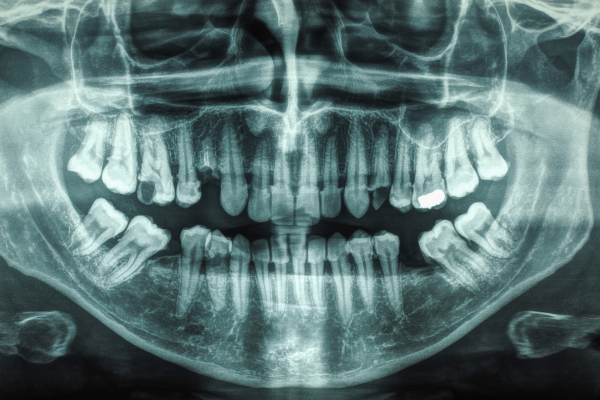

There are 5 types of dental X-rays, used for different purposes.
Bitewing – These show the upper and lower back teeth (molars) on one small film. This type of X-ray is especially useful for showing cavities between teeth and changes in bone caused by periodontal disease.
Periapical – This X-ray shows the entire tooth, including all of the roots and surrounding tissues, on one small film. These X-rays show many kinds of disorders, including impacted teeth, fractures, abscesses, cysts, and tumors.
Full-mouth Series – This is a complete set of bitewing and periapical X-rays that show all of the teeth, roots, and related areas of the jaws. The number of pictures taken varies depending on the size and shape of the mouth and teeth.
Panoramic – A panoramic view X-ray shows all the upper and lower teeth, large portions of the jaws and other structures in one large picture. It is often used to find unerupted teeth, cysts, fractures, retained root fragments, and other conditions of the jaw. It does not generally show enough detail to be useful for detection of decay and bone loss from periodontal disease.
Cephalometric – These X-rays are sometimes called headfilms. They show all of the bones of the face and skull. This type of X-ray is used to evaluate growth, development, and skeletal relationships.
There is a lot of confusion and concern about the radiation from dental radiographs. People are exposed to natural background radiation all their lives – an estimated 80 millirem (mrem) of radiation every year for the average person. While background radiation impacts the entire body continuously, diagnostic X-rays affect only a small part of the body for a very short time.
With modern techniques and equipment, such as the digital radiography system we use, the amount of radiation received in a dental examination is extremely small – less than a fifth of the radiation of old systems. The tissues exposed to dental x-rays (teeth, jaw, cheeks) are not as susceptible to radiation damage as rapidly dividing tissues such as reproductive organs and bone marrow. Therefore, the risk of harmful effects from dental X-rays is negligible. Even so, Dr. Joe will only recommend X-ray examinations when necessary.
Stay in touch with our office and receive dental advice, conveniently delivered to your inbox.
© 2025 JA Haselhorst DDS LTD. All Rights Reserved.
